



Saudi Arabia, Pakistan and Türkiye Sign Makkah Joint Defence Agreement
VOK NEWS/Kathmandu, 2026 August 8- Saudi Arabia, Pakistan and Türkiye have signed a significant Makkah Joint Defence Agreement amid growing security tensions and a changing strategic landscape in West Asia.
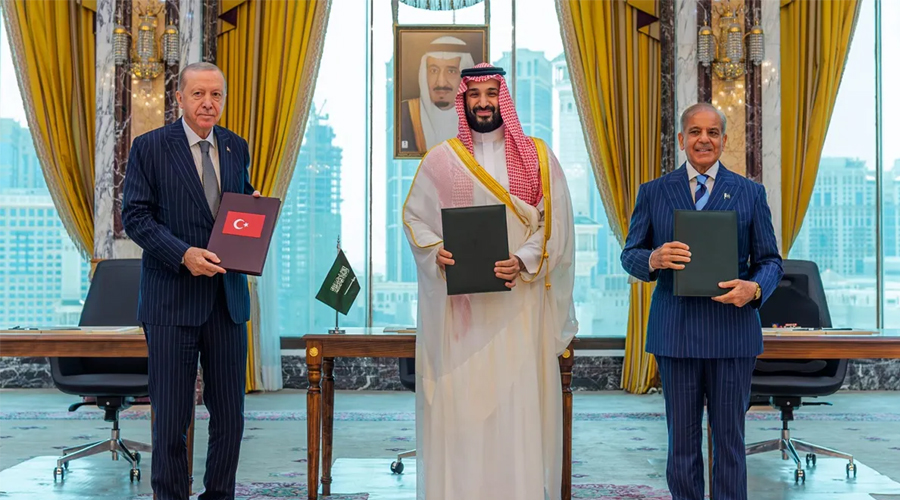
The trilateral agreement was signed in Makkah on Friday during a high-level meeting attended by Saudi Crown Prince and Prime Minister Mohammed bin Salman, Pakistani Prime Minister Shehbaz Sharif and Turkish President Recep Tayyip Erdoğan.
Under the agreement, an armed attack against any one of the three countries will be considered an attack against all three. The arrangement is expected to strengthen collective defence and security cooperation among the three influential Muslim-majority countries.
The agreement focuses on closer defence cooperation, strengthening collective deterrence capabilities, and promoting regional peace and stability. However, the three countries have not officially described the arrangement as an “Islamic NATO” or an alternative to NATO. They have also emphasized that the agreement is defensive in nature and is not directed against any particular country.
Saudi Arabia’s economic and strategic influence, Pakistan’s military strength and nuclear deterrent capability, and Türkiye’s military experience, defence industry and regional diplomatic activism give the agreement considerable strategic significance.
The announcement comes at a time when West Asia is experiencing growing tensions, conflicts and competition among regional and global powers. Analysts say the agreement could open the door to a new form of collective security cooperation among regional powers beyond traditional security partnerships.
Some observers have even linked the development to the possibility of a future NATO-like regional security mechanism. However, describing the Makkah agreement as an immediate alternative to NATO would be premature.
NATO has an established institutional structure, long-term membership arrangements and a well-developed collective defence mechanism. The actual significance of the Makkah agreement will therefore depend on how its provisions are implemented, how military cooperation develops, and whether the three countries establish a broader institutional framework in the future.
The agreement could nevertheless have important implications for the regional balance of power. Saudi Arabia has been seeking to strengthen its security capabilities, while Pakistan and Türkiye possess significant military expertise and strategic influence. Their closer cooperation could therefore create a new security equation in West Asia.
The development may also have indirect implications for Nepal. A large number of Nepali citizens are employed in the Gulf and West Asian countries. Any deterioration in the regional security environment could affect the safety of Nepali migrant workers, foreign employment and remittance flows.
Nepal should therefore closely monitor the changing international security landscape and assess such developments primarily from the perspective of its national interests and the safety of its citizens working abroad.
Ultimately, the significance of the Makkah Joint Defence Agreement will depend on whether it contributes to regional peace and stability or becomes another platform for military competition.
For now, the agreement should be viewed not simply as a defence pact between three Muslim-majority countries, but as a potentially important development in the evolving security and power balance of West Asia.